
The Strength of Fathers Who Cannot Protect Enough
Diplomats sign papers in air-conditioned rooms. Fathers dig up their children with raw fingers.
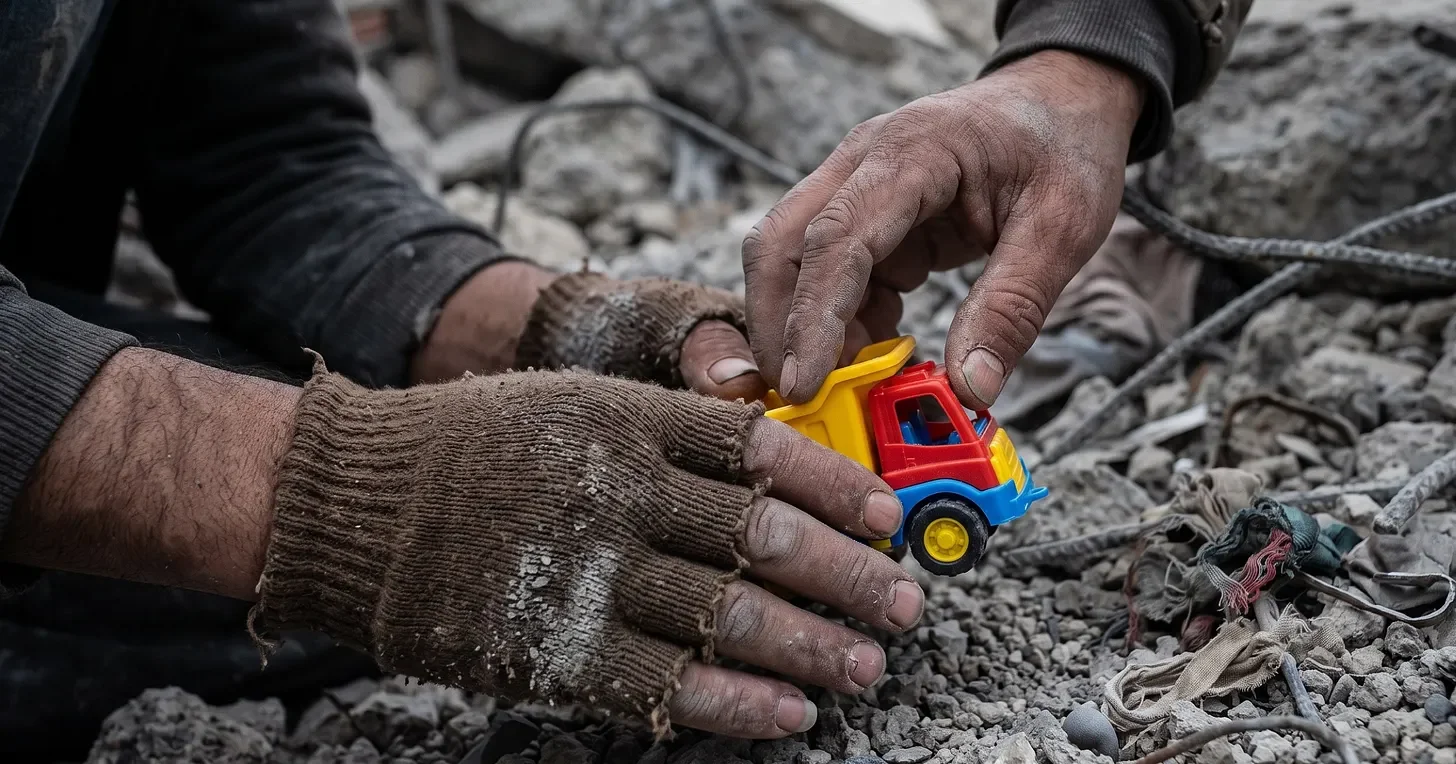
The dust does not settle. It hangs suspended in the thick, midday heat, dry and chalky, coating the back of your throat with the taste of pulverized limestone and the metallic tang of blood.
In the blinding light, a man walks down an asphalt road.
His hand tightly grips a much smaller one—warm, soft, its small fingers occasionally twitching as the child skips every few paces to match his stride. The silence between them is heavy, broken only by the rhythmic scrape of worn shoes on loose gravel.
There is no warning whistle. No shadow cast across the sunlit ground. Just a sudden, concussive tear in the air, a flash of white heat, and then an absolute, violent stillness.
When the cloud of pulverized rock finally thins, the road is cratered. The smaller hand is no longer in his.
Miles away, inside the suffocating canvas heat of a displacement camp, another man is on his knees. He isn’t moving down a road; he hasn’t moved from this exact patch of dirt in months.
His hands—caked in gray grit, fingernails split to the quick and oozing dark blood—claw uselessly at a mountain of jagged concrete slabs. Beneath hundreds of tons of crushed ceiling lies everything he ever built: four children whose voices he has not heard in years. He doesn’t stop. He digs with raw, peeled fingers because there are no machines coming. No rescue teams. No heavy engines to lift the weight. There is only him, his bleeding palms, and the decaying silence of his own home.
You read this and your chest tightens.
You feel a cold knot of sympathy form in your stomach. Your mind automatically reaches for a category to hold this horror, filing it away as a dark chapter from an ancient empire’s fall, or perhaps a bleak, exaggerated scene from a dystopian novel designed to make you appreciate the quiet safety of your own living room.
This is not ancient history. This is not fiction. This is Gaza, right now, in 2026.
Shatter the distance you just built. Throw away the comforting illusion that you are safe in a chair reading about something far removed from your life.
While you scroll through headlines, sip your morning coffee, or debate the geopolitical theater taking place on television screens, this exact nightmare is actively playing out in real-time. The dirt on those fathers’ hands is still wet. The air in those tent camps is still thick with dust.
There is no distance between your comfort and their reality except a geographical boundary and a terrifying amount of human indifference.
While international newsrooms reposition their cameras toward broader geopolitical escalation, fretting over military maneuvers between the United States, Israel, and Iran, the daily, mechanical execution of an entire population has been relegated to background noise.
The global apparatus has decided that Gaza is an old story. It hides behind sanitized, PR-tested vocabulary, assuring the world that a “ceasefire” is in place, that “hostilities have ceased.”
It is a grotesque, calculated lie.
A ceasefire that permits daily bombardment is not peace.
It is a managed siege. Since this so-called “cessation of hostilities” was declared, over 640 Palestinians have been slaughtered. The bombs do not pause for diplomacy; they simply operate without the burden of global scrutiny.
In central Khan Younis, a targeted drone strike tears through the quiet of a morning road, killing a father and his young daughter in an instant—followed hours later by another strike in the same city that leaves a child fighting for her life on a cold hospital tray.
In a crowded displacement camp, a six-year-old girl steps out to play at the fabric doorway of her family’s tent, only to be struck down by artillery fire. In the village of Khirbet Shuweika, violence wears a different face: a father and his young child are intercepted and beaten across their heads with sharp tools by settlers, their skulls fractured before they can even scream.
Axiom: When violence is rebranded as “compliance,” passivity becomes an act of complicity.
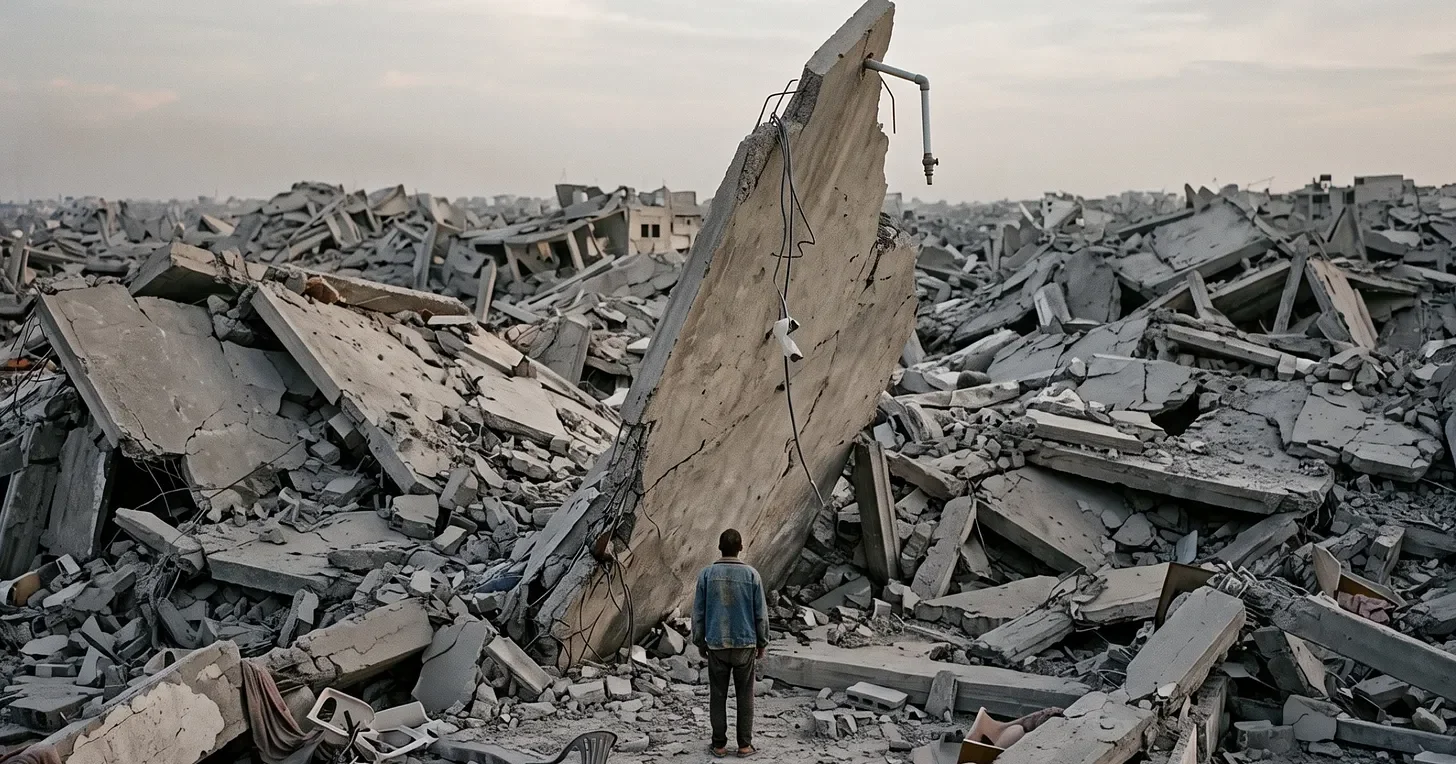
And beneath it all lies the quiet, suffocating horror of the rubble. An estimated 10,000 human beings remain missing, trapped under millions of tons of crushed concrete. This is not an accident of infrastructure; it is structural cruelty by design. For months, the blockade has systematically banned the entry of heavy excavation machinery.
Think about what that means. It means the global order has decided that a father in Al Bureij must spend years picking through the jagged remnants of his home with his bare palms. It means forcing a man to live alongside the decaying remains of his own children because the world refuses to allow a crane through a border checkpoint.
To call this an operational delay is a coward’s defense. It is the deliberate, ongoing erosion of human dignity.
The Cost of Looking Away
You will feel a brief, uncomfortable pang reading this. Your throat might tighten for a second. You might shake your head, whisper that it’s awful, and then swipe down to the next post.
That is grief voyeurism.
It is the cheap, comfortable illusion of moral outrage, consuming another human being’s total obliteration as a momentary emotional pitstop on your digital feed, only to resume your day untouched.
Let the mirror shatter that indulgence.
When you consume the unvarnished reality of an ongoing siege, feel a brief flicker of sadness, and return to quiet inaction, you are not a helpless bystander. You are a participant in the normalization of cruelty.
Silence is not neutral. Distance is not an excuse. Standing still inside a broken, violent system while an entire generation is systematically erased with your passive consent is an active choice to protect your own comfort over another person’s right to exist.
The line is drawn. You can no longer pretend you did not know. You can either retreat into the cowardly safety of looking away, or you can carry the heavy, uncompromised weight of active alignment.
Choose where you stand.
You cannot weep for the child under the rubble while remaining silent about the hand holding the shovel.
